How to decide – Asking the economist in me

I love thinking about how to make a decision. This for me is one of the main reasons I love being a researcher. It’s fun coming up with a framework, an approach to finding an answer. Having a big decision to make, like whether to have a baby or not, requires a lot of planning about how to make the decision.
My belief is that approaching a topic from multiple angles is valuable, even necessary to make the right decision. It allows you to see it with a 360 degree view, really get into those hidden cracks and shine a light on different aspects. I try to take as many perspectives as I can. How would an economist approach this? How would a researcher approach this? How would someone who is moving country and continent a lot approach this? How would an introvert approach this? How would a freedom-lover approach this? You get my point. I try to find aspects of my personality, Lena personas if you will, that offer a certain viewpoint or represent a set of needs and beliefs and I let them speak.
And so I’ve thought about frameworks I know from my economics days and had a bit of fun applying them to the child question. I might try the same with other Lena personas, so stay tuned on that one. For now, here are three econ ideas that I found interesting to explore.
1. Historical data doesn’t predict my future.
Economists use historical data to predict what will happen in the near future. Like looking at past business cycles to determine where we are in the current one. Looking at seasonality within data and using past adjustments to understand what might happen this year. Looking at past leading indicators to forecast how long it will take to stimulate the economy this time around. You get the idea. Often, historical data is our best guess and relying on it makes sense. But there’s this story about a turkey that always comes to my mind when talking about relying on historical data. The turkey lives a happy life. Each day is great: the turkey sleeps securely in its hut, gets up, eats, spends time outside, sees its turkey friends living their best life, etc. Relying on historical data to predict its future, the turkey thinks that’s how life will be forever. Until Thanksgiving.
What in the world does that have to do with deciding whether to have a child?! Fair question. Somehow it gives me comfort that my past doesn’t predict my future. It always has – I’ve taken great joy in re-inventing my life multiple times. Moving to different countries, changing professions, adopting a new language (my native tongue is German). It gives me permission to change my mind and disregard what I did or said in the past. I’ve definitely said that I don’t think I want to have a child. I’ve usually softened it with ‘I may change my mind’ but I feel many people would be surprised to hear I’m considering it now. Only because I’ve never had a child in the past doesn’t mean I won’t have one in the future. I’m free to choose. Any day could be the day I decide to change my future. And that’s a really freeing thought.
2. I want to find my global maximum.
Daniel and I both have this idea, or rather this quest, to reach the the global maximum of our lives. We explore options: rather than staying on one path trying to reach a local maximum, we jump to another path with a higher local maximum that was unreachable from the previous path. To illustrate, think about our life choices as a map like this:
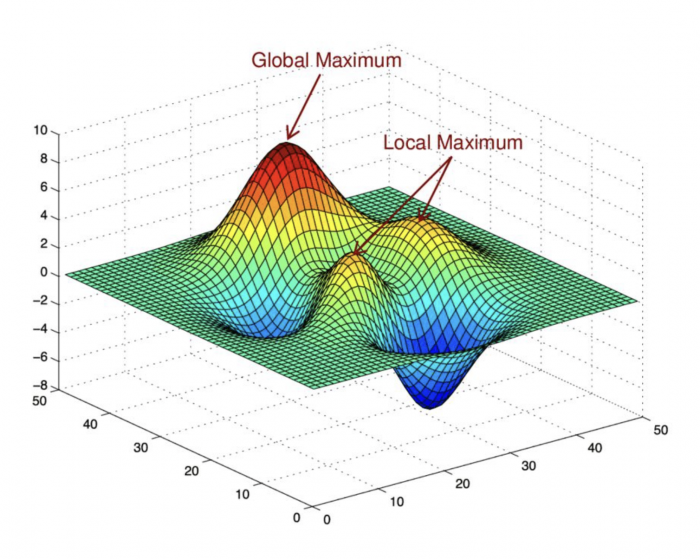
Think of all lines representing a path, a possible life we could lead. There are three maxima (the good places we want to get to in life), but only one is the global maximum (the highest and best possible). A path that leads to a local maximum doesn’t necessarily lead to the global maximum – you have to switch paths to reach the global maximum.
Let me give an example to illustrate. I studied economics at university. My first job out of uni was every economist’s dream: I worked at Australia’s central bank. A position that is prestigious, well paid, academic and surrounds you with incredibly smart and nice colleagues. I made it. I was on a path to great success if I wanted to be an economist. And even if I didn’t care too much about econ, this was still a good deal. Great benefits, cushy nine-to-five job. I could have easily stayed on this path and reaped the not-bad-at-all benefits. This was leading to the local maximum of being an economist in Australia. But I was unconvinced that this was the best life I could have. I quit and we moved to Germany where I started a job in a tech company on much lower pay and prestige level. But I progressed quickly and worked my way towards the local maximum on the tech employee path, which was higher than the local maximum on the economist path.
Don’t think about this as just relating to jobs or pay or prestige. My example makes it sound a little like that, but I simply chose it because it’s easy to understand. It’s not at all just about these things. It’s about life at large. The question was always: what will lead us to our global maximum life? We decided to move to Germany not because we thought job prospects were better (Germany is definitely lower wage than Australia on average) but because we wanted to be in a place that’s less isolated, more international and exciting.
When I started thinking about life like this, it felt less scary to try new things. In many ways it seemed like the only sane choice to explore and move on if something didn’t feel quite right. There was a higher maximum waiting out there, ready for me to climb it! It’s led me to live in many different places, quit jobs without an alternative lined up, try new hobbies, and generally remain open to new experiences and people.
Relating this back to the baby decision (finally, I know). The question for me is this: would a baby push us onto a new path with a higher maximum? What if it’s the opposite and a baby would put us on a lower maximum path?
I love where we are in life right now. We have worked hard, explored so many options and have arrived on a path that we are both proud of and really happy with. I think our happiness comes from knowing our alternatives, knowing we’ve tried many paths and have finally found a great fit. It’s scary to consider jumping on a new path. We have a lot to lose. This feeling has never held us back before – we’ve jumped many times without knowing if it would be better or worse on the new path. The difference is that all decisions have been reversible so far. We could move back to Australia, switch back to an old career, etc. We never needed this safety net, but it was a good way to convince us to just try something new – what’s the worst that could happen? Last time I checked though, there’s not really a good way to reverse a baby.
And so the question is: are we willing to take a chance on a new path even if this time we don’t get a safety net? How far am I willing to go in search for my global maximum?
3. A baby could be part of my life portfolio.
You’ve probably heard of the portfolio approach in finance. It’s the idea that you should invest not just in one asset, but in a bunch of different assets, preferably ones that aren’t closely related (so if the value of one goes down, others hold their value or better yet, increase it). This is to hedge your investment, to make sure that you don’t lose everything in one unlucky swoop.
I have for a while thought about my life as a portfolio. Imagine a hand of cards that create the perfect deck to win. Win at life, that is. One of my cards is my health, another is Daniel, family, friends, hobbies, work, money… You get the idea. Over the years, I’ve made changes to my portfolio. I’ve brought in new friends and kicked out some old ones, have lessened the weight of family, have added pottery as a hobby (which makes me so happy), have added strength training and saying no to everything I’m not excited about.
All of these assets in my life portfolio constantly wrestle for more space, more weight. And that’s fine – sometimes I focus strongly on healthy eating, then I relent and let comfort and eating out with friends take over for a while. I’m happy to be flexible on some of these. I’ve also become more rigid on others: I never want to deprioritize Daniel or friends and I never want to say yes to things I don’t want to do.
The question has always been: how do I build a life that is robust in happiness? What assets do I add to my portfolio? Which ones are in it now? And which ones should be taken out or added?
And the more recent question is: what would happen if I add a baby?
When I envision life with a baby, I try to imagine which assets in my portfolio it would crowd out. Which ones am I happy to give up? Which ones would I need to give up? And which ones can I not live without? And also: are my assumptions correct or are they modeled on what I think should happen? How much is it in my control to arrange my portfolio after I’ve added a baby?
Until recently, I believed that a baby would eliminate all other assets in my portfolio. Observing young parents and thinking back to how my family was, I was convinced that life was over after having a baby. I’d be serving the baby’s needs. I would be needless. Or at least pretend to be. Can you see why I didn’t want a baby?
I’m really lucky to have found friends who have modeled a completely different life. Through them I learned that this is not the fate I’d have to accept. They are first and foremost themselves and oh yeah, they are also the parents to a super cute daughter. They dote on her and love family time, but they also continue to work, to have hobbies, to meet with friends, to have conversations that don’t revolve around children. It’s refreshing and it’s shown me that adding a child to my portfolio could be great.
I am so happy I learned this at a time in my life when the baby question needs to be answered.